


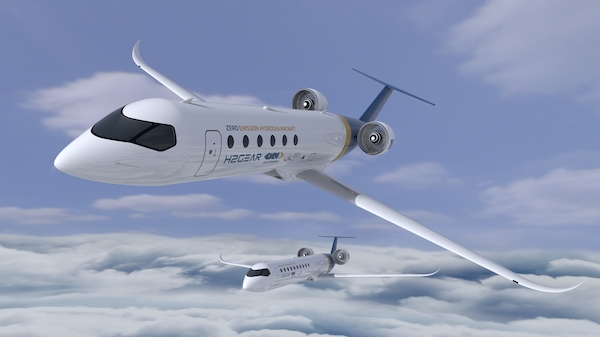
easyJet is working with GKN Aerospace to work toward reducing carbon emissions in aviation through the adoption of zero carbon emission technologies. easyJet will support the development of GKN Aerospace’s Hydrogen Combustion (H2JET) and Hydrogen Fuel Cell (H2GEAR) technology, including exploring the options for flight demonstration, as part of the airline’s ambition to de-carbonise aviation. Among others, easyJet will provide insights into operational requirements and economics.
H2GEAR is a GKN Aerospace led ground-breaking UK collaboration programme aiming to develop a liquid hydrogen propulsion system for sub-regional aircraft that could be scaled up to larger aircraft. Liquid hydrogen is being converted to electricity within a fuel cell system. This electricity efficiently powers the aircraft, eliminating carbon emissions and creating a new generation of clean air travel.
The H2GEAR programme is supported by £27M of ATI funding, matched by GKN Aerospace and its industrial partners.
H2JET is a Swedish collaborative two-year programme led by GKN Aerospace to push development of key subsystems for gas turbine-based hydrogen propulsion of medium range civil aircraft.
David Morgan, Director of Flight Operations, easyJet, commented: “At easyJet, we are committed to working towards a future with zero carbon emission flying. We know that technology is a key driver to achieve our decarbonisation targets, with hydrogen propulsion a frontrunner for short-haul airlines like easyJet. Cross-industry partnerships are key to developing these promising new technologies and we look forward to collaborating with GKN Aerospace to support bringing this technology to maturity as early as possible.”
Max Brown, VP Technology, GKN Aerospace, said: “At GKN Aerospace sustainability is at the heart of our business. Hydrogen-powered aircraft offer a clear route to keep the world connected, with dramatically cleaner skies. The UK is at the forefront of this technology. We look forward to work with easyJet and our partners, to develop and industrialise the breakthrough technology to fly aircraft with zero CO2 emissions.”
Championing the development of a zero carbon emission aircraft to de-carbonise aviation is a key focus for easyJet, and the airline is working with partners across the industry like GKN Aerospace, as well as Airbus, Rolls-Royce, Cranfield Aerospace Solutions and Wright Electric, to accelerate the development of zero carbon emission technologies and supporting infrastructure. The airline is optimistic that it could begin flying customers on planes powered by hydrogen-combustion, hydrogen-electric or a hybrid of both by the mid to late-2030s.
In November last year, easyJet joined Race to Zero, a global UN-backed campaign to achieve net-zero carbon emissions by 2050 at the latest. In joining Race to Zero, the airline committed to setting an interim science-based target for 2035 and to reaching net-zero carbon emissions by 2050, for which technology for zero carbon emission flying will play an important part.
In 2019, easyJet became the first major airline worldwide to offset the carbon emissions from the fuel used for all its flights and remains the only major airline in Europe to do so. This comes at no additional cost to its customers and the airline only supports projects that are certified by either Gold Standard or Verified Carbon Standard. This is an interim measure to address its impact on the environment in the short-term.
Beyond carbon, easyJet is focusing on reducing plastic – more than 36 million single-use plastic items were eliminated – as well as reducing waste within its wider operations and the supply chain. The airline also introduced new crew uniforms made from recycled plastic bottles. With 45 bottles in each uniform this has the potential to prevent 2.7 million plastic bottles from ending up in landfill or in oceans over the next five years.
Global Jet Capital has released its sixth annual Business Jet Market Forecast, outlining a confident outlook for the sector. The updated analysis anticipates steady expansion over the next five years,...
Regional turboprop fleets show stark disparities in age, reliability, and economic viability. Many aircraft are approaching end‑of‑life, while others are increasingly difficult to operate as spare‑par...
Uzbekistan Airways and Lufthansa Technik have renewed their cooperation with a long‑term agreement extending comprehensive component support for the airline’s Boeing 787 Dreamliner and Airbus A3...
TARMAC Aerosave, Europe’s leading specialist in aircraft storage, maintenance, dismantling and recycling, has announced an expanded collaboration with AerFin, the global aviation asset‑managemen...