


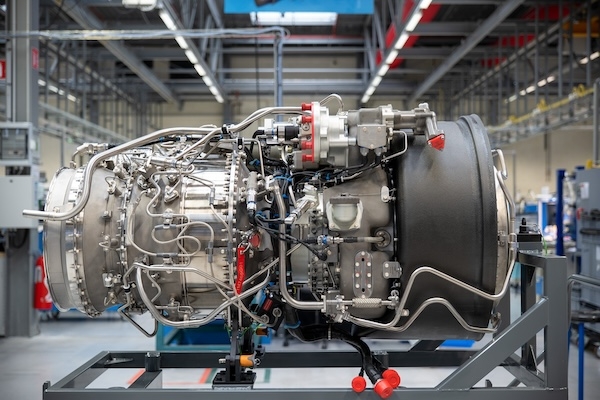
Safran Helicopter Engines has received certification for its Aneto-1K from the Civil Aviation Administration of China. This crucial milestone paves the way for the Leonardo AW189K's introduction into the Chinese civil market. This validation of type certificate by China succeeds the earlier type certificate by the European Union Aviation Safety Agency in 2019.
Valentin Safir, Safran Helicopter Engines Executive Vice-President, Programs commented: "Having received certification across Europe and Brazil, the Aneto-1K has now obtained certification in China, a pivotal development in the worldwide rollout of the AW189K. Equipped with our cutting-edge engine, the AW189K is particularly well-suited for the most demanding helicopter transport missions, in the most difficult conditions.”
The 2,500-shp Aneto-1K is the first model in the Aneto engine family, covering a power range from 2,500 to 3,000 shp and designed for super-medium and heavy helicopters.
Aneto engines are 25% more powerful and more responsive than existing engines of the same size. This additional power margin contributes to increase helicopter capabilities during missions, such as offshore, transport, search and rescue and fire-fighting. This translates in particular into increased payload during flights in “hot and high” conditions.

Honda Aircraft Company announced the completion of the first wing structure for the HondaJet Echelon test aircraft, marking a pivotal advancement in the program and moving the new light‑jet platform i...
Samson Sky, developer of the Switchblade Flying Car, announced it has secured an $80 million investment from Dubai‑based Matin Group. According to Sam Bousfield, CEO, Founder...
EHang announced its extensive involvement in the FIA Sustainable Innovation Series held in Madrid during the Formula 1 Spanish Grand Prix week. Organized by the Fédération Internationale...
Regional turboprop fleets show stark disparities in age, reliability, and economic viability. Many aircraft are approaching end‑of‑life, while others are increasingly difficult to operate as spare‑par...