


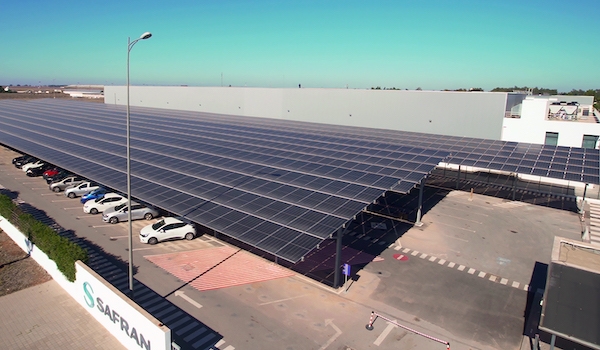
Safran, working with Réservoir Sun and Idex, will generate part of the energy it uses by installing solar panels at 17 of its sites in France. With a total capacity of almost 50 MWp, the photovoltaic arrays will be installed mainly on parking lot shade structures and will cover a total area of just under 180,000 square meters (1.9 million sq.ft). Approximately 39 GWh (gigawatt hours) per year will be generated for self-consumption at the sites and will cover an average of 15% of their requirement.
Thibaud Normand, Safran’s Vice President Climate, commented: “Safran continues to implement its action plan to achieve its environmental targets and is installing photovoltaic panels at its French sites, working with partners Réservoir Sun et Idex, who are experts in this field.”
Installation work managed by the two partner companies will begin this year and will continue through to the first quarter of 2025. The Safran Nacelles industrial facility in Gonfreville-l’Orcher (Normandy) will be the first site to come on stream, in June this year. The system at Safran Aircraft Engines in Évry-Corbeil (near Paris) will be one of the largest self-consumption PV arrays on any industrial site in France. A second phase will later be launched to install solar arrays at more than 40 Safran facilities in France.
Safran is pursuing the same initiative in the rest of the world, with PV installation projects completed or planned at its sites in Australia, Belgium, China, Malaysia, Mexico, Morocco, Singapore, Thailand, Tunisia and the United Kingdom. Systems generating a total of almost 24 MWp have been or are being installed for self-consumption.
Rollout of these PV systems is part of Safran’s broader strategy to reduce its carbon footprint. The objectives of this strategy have recently been validated by independent body the Science Based Targets initiative (SBTi). Safran is committed to a 50.4% reduction in its Scope 1 (direct) and Scope 2 (indirect) emissions related to the energy consumption of its operations by 2030, compared to a 2018 baseline.
Drukair – Royal Bhutan Airlines, the national flag carrier of the Kingdom of Bhutan, has announced its decision to equip five Airbus A320neo‑family aircraft with CFM International LEAP‑1A engine...
easyJet has introduced reusable crew meal trays, developed in partnership with Ecoffee Cup, across its UK and European fleet—cutting onboard waste and strengthening the airline’s wider sus...
Regional turboprop fleets show stark disparities in age, reliability, and economic viability. Many aircraft are approaching end‑of‑life, while others are increasingly difficult to operate as spare‑par...
Qantas has inaugurated its new Product Innovation Centre in Adelaide, with South Australian Premier Peter Malinauskas joining Qantas Group Chief Technology, AI and Transformation Officer Rachel Yangoy...