


To discuss the latest conceptual airliner of Airbus we would need first go back in history, some centuries back... The desire of human been to fly, first steps and first disapointments... A man still watching birds flying searching for answers how to fly like they do... All that time, in fact, it was biomimicry ...
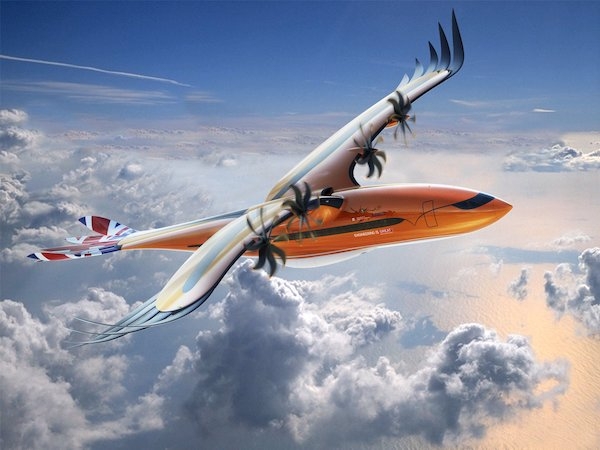
During Royal International Air Tattoo air show, Airbus has unveiled a bird-like conceptual airliner design “Bird of Prey”. It is not the actual aircraft,
it is the theoretical design is a hybrid-electric, turbo-propeller aircraft for regional air transportation. It has the goal - to motivate the next generation of aeronautical engineers, underscoring how they can make a difference by applying technologies researched at the company in hybrid-electric propulsion, active control systems and advanced composite structures. Inspired by efficient mechanics of a bird, it has wing and tail structures that mimic those of a bird of prey, while featuring individually controlled feathers that provide active flight control.
"One of the priorities for the entire industry is how to make aviation more sustainable – making flying cleaner, greener and quieter than ever before. We know from our work on the A350 XWB passenger jet that through biomimicry, nature has some of the best lessons we can learn about design."
Martin Aston - Senior Manager at Airbus.
Biomimicry’s potential in aircraft design
While not intended to represent an actual aircraft, Airbus’ “Bird of Prey” is based on realistic ideas – providing an insight into what a future regional aircraft could look like. It includes a blended wing-to-fuselage joint that mirrors the graceful and aerodynamic arch of an eagle or falcon, representing the potential of biomimicry (the design and production of materials, structures and systems inspired by nature).
“Our ‘Bird of Prey’ is designed to be an inspiration to young people and create a ‘wow’ factor that will help them consider an exciting career in the crucially-important aerospace sector,” explained Martin Aston, a senior manager at Airbus. “One of the priorities for the entire industry is how to make aviation more sustainable – making flying cleaner, greener and quieter than ever before. We know from our work on the A350 XWB passenger jet that through biomimicry, nature has some of the best lessons we can learn about design. Who can’t help but be inspired by such a creation?”
ExecuJet MRO Services South Africa, a wholly-owned subsidiary of Dassault Aviation, will be exhibiting at the Africa Aerospace & Defence (AAD) Expo 2026 at Waterkloof Air Force Base in Pretoria (1...
Qantas has inaugurated its new Product Innovation Centre in Adelaide, with South Australian Premier Peter Malinauskas joining Qantas Group Chief Technology, AI and Transformation Officer Rachel Yangoy...
Boeing and American Airlines announced the successful completion of the first landing gear exchange for a 737 MAX, marking a key milestone as the company extends its longstanding Landing Gear Exchange...
Regional turboprop fleets show stark disparities in age, reliability, and economic viability. Many aircraft are approaching end‑of‑life, while others are increasingly difficult to operate as spare‑par...