


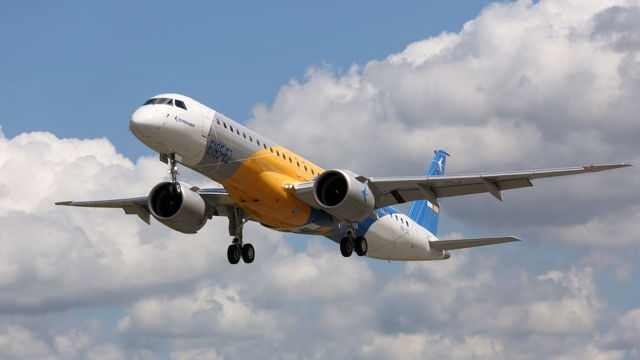
Ten months after the first flight of the E190-E2, Embraer performed the inaugural flight of another member of the E2 family, ahead of schedule. This Wednesday, the E195-E2, the largest aircraft of the family–and the most efficient aircraft in the single aisle jet market—took off for the first time. The flight, originally scheduled for the second half of the year, happened just three weeks after the roll out.
“With a unique level of efficiency, the E195-E2 offers our airline partners the opportunity to develop new markets with greater profitability without compromising unit cost competitiveness. It’s a profit-hunting machine,” said John Slattery, President & CEO, Embraer Commercial Aviation.
With a 20% lower cost per trip and a cost per seat similar to larger aircraft, the E195-E2 is the ideal aircraft for regional business growth as well as to complement existing low-cost business plans and mainline fleets. The airplane will save up to 24% in fuel and 20% in maintenance costs per seat, when compared to the current E195.
The E195-E2 departed at 11:22 a.m., local time, from Embraer’s facility in São José dos Campos, Brazil, and flew for two hours, beginning the aircraft certification campaign. Staffed by pilots Márcio Brizola Jordão and José Willi Pirk, as well as flight engineers Celso Braga de Mendonça and Mario Ito, the flight crew evaluated aircraft performance, flight quality and systems behavior, such as autopilot, fly-by-wire in direct mode, and the landing gear retraction.
“With 1.4 meters longer wingspan than the E190-E2, the E195-E2 becomes the aircraft with the highest aspect ratio among single-aisle jets thus increasing fuel efficiency” explained Luís Carlos Affonso, COO, Embraer Commercial Aviation. “We also applied experience from over 17 million hours of flight and 100 jet airline customers to develop the E195-E2 with the most competitive life cycle cost in the industry.”
Embraer will use two aircraft for the E195-E2 certification campaign. The first prototype will be used for the aerodynamic and performance tests. The second prototype, which will also make its inaugural flight by the end of this year, will be used for the validation of maintenance tasks and of the interior. The E195-E2 will entry into service in the first half of 2019, with Azul Brazilian Airlines.
The E195-E2 has three additional rows of seats, when compared to the current generation E195, and it can be configured with 120 seats in two classes of service, or up to 146 in a single class. The aircraft also has a significant increase in range of 450 nautical miles, which allows trips of up to 2,450 nautical miles.
The E2 has accrued 275 firm orders, being 90 for the E195-E2, in addition to 415 options, purchase rights, and letters-of-intent, totaling 690 commitments from airline customers and leasing companies. Currently, the E-Jets are operating with about 70 customers in 50 countries, being the global leader in the segment of aircraft with up to 130 seats, with over 50% market share.
Global trade body The Air Charter Association (The ACA) celebrated another record‑setting edition of Air Charter Expo (ACE’26) on Tuesday, 8 September 2026, delivered in partnership with Busines...
Global Jet Capital has released its sixth annual Business Jet Market Forecast, outlining a confident outlook for the sector. The updated analysis anticipates steady expansion over the next five years,...
Boeing and American Airlines announced the successful completion of the first landing gear exchange for a 737 MAX, marking a key milestone as the company extends its longstanding Landing Gear Exchange...
Uzbekistan Airways and Lufthansa Technik have renewed their cooperation with a long‑term agreement extending comprehensive component support for the airline’s Boeing 787 Dreamliner and Airbus A3...