


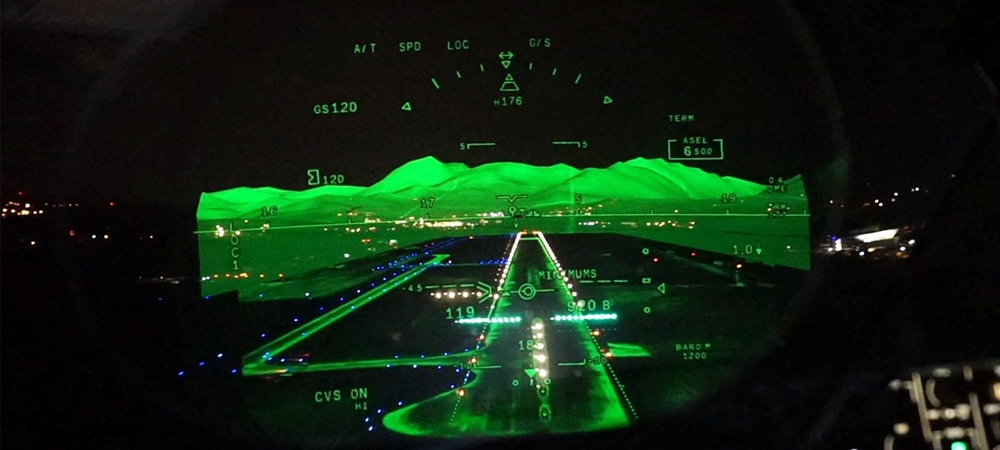

The Dassault Falcon 900LX, Falcon 2000LXS and Falcon 2000S have been certified by EASA and the FAA for an enhanced flight vision system (EFVS) capability that greatly improves access to airports in bad weather, providing operational credit for poor visibility approaches down to 100 ft.
The new EFVS capability, provided through Dassault Aviation’s revolutionary FalconEye Combined Vision System (CVS) and its unique combination of six fused sensors, was previously certified on the Falcon 8X ultra-long range trijet following the completion of joint EASA/FAA trials last year.
FalconEye is the first Head-Up Display (HUD) to show separate synthetic, database-driven terrain mapping and enhanced thermal and low-light camera images at the same time. It also allows pilots to adjust the split between synthetic vision system (SVS) and enhanced vision system (EVS) imaging areas to suit visibility conditions, providing an unprecedented level of situational awareness and allowing the crew to perform bad weather landings with much higher levels of confidence, precision and safety.

The FalconEye option has been available on the two-engine 2000LXS/2000S and the three-engine 900LX since October 2016 and on the Falcon 8X since early 2017. The system will also be available on the new Falcon 6X ultra widebody twinjet, which is due to enter service in 2022.
The next enhancement to the FalconEye option will be the addition of a dual head-up display configuration that will support an EFVS-to-land capability, allowing pilots to fly a full approach and land without requiring natural vision to see the runway. The full approval of this capability is anticipated next year.
The recent operational improvement to FalconEye and certification is part of a series of enhancements and new options designed to extend Falcon mission capability. Others include Dassault’s Falcon Sphere II integrated Electronic Flight Bag (EFB) suite and FalconConnect, a comprehensive package of broadband communications solutions designed to facilitate the use, management and control of inflight connectivity.


Airbus has officially unveiled a new delivery center at its Jean‑Luc Lagardère site, northwest of Toulouse, marking a significant milestone in the industrial ramp‑up of the A320 Family. Purpose...
Honda Aircraft Company announced the completion of the first wing structure for the HondaJet Echelon test aircraft, marking a pivotal advancement in the program and moving the new light‑jet platform i...
Qantas has inaugurated its new Product Innovation Centre in Adelaide, with South Australian Premier Peter Malinauskas joining Qantas Group Chief Technology, AI and Transformation Officer Rachel Yangoy...
Boeing and American Airlines announced the successful completion of the first landing gear exchange for a 737 MAX, marking a key milestone as the company extends its longstanding Landing Gear Exchange...