


Boeing and SpaceX are racing to become the first private companies to carry astronauts into space, as early as next year.
And although SpaceX is generally considered to be leading the race (it already delivers supplies to the space station), Boeing shouldn't be underestimated (the company built most of the International Space Station).
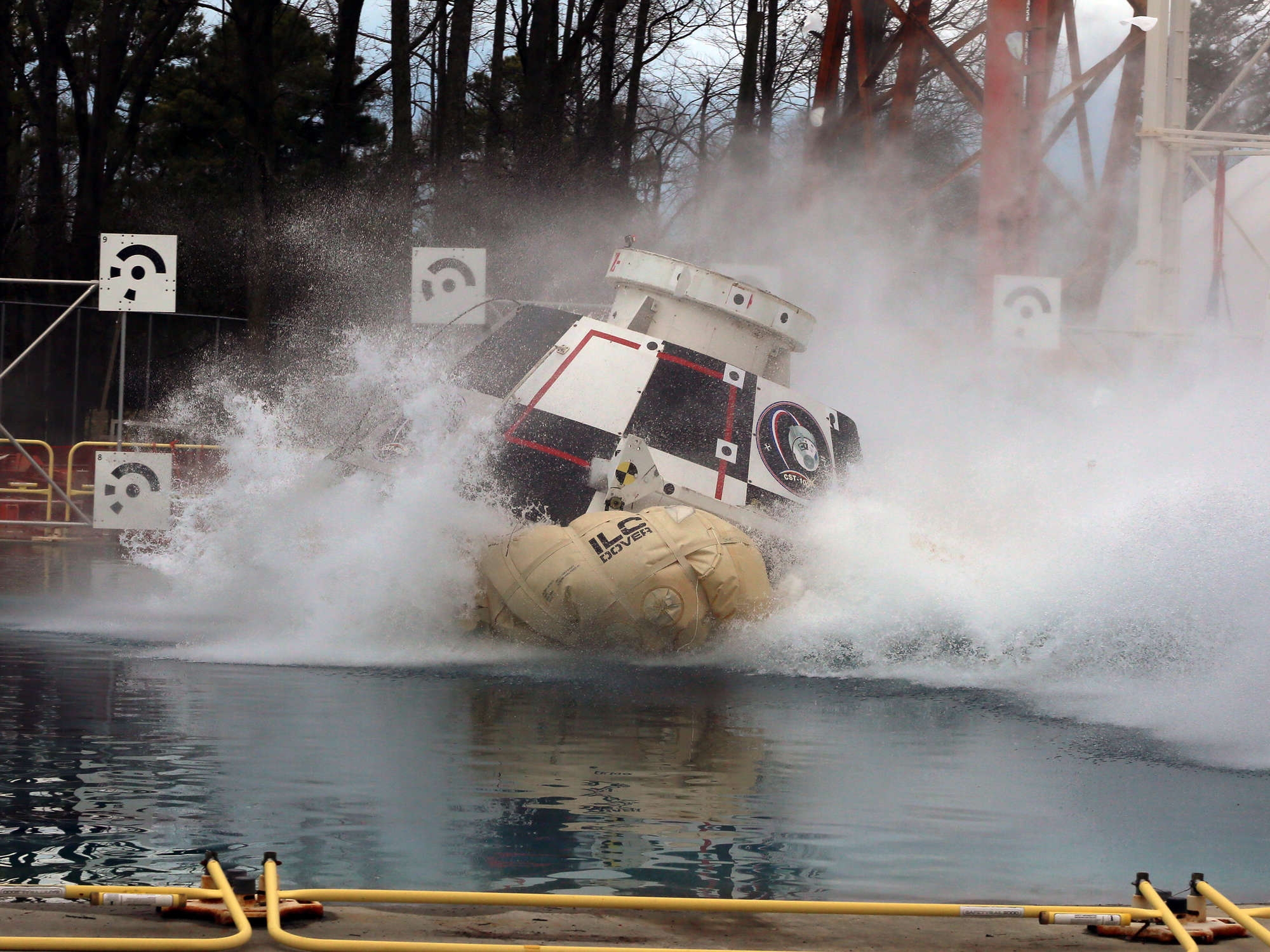
After carrying astronauts to space, Boeing's crew capsule, the CST-100, a.k.a. "Starliner", would use parachutes to land softly on the ground. But in some emergency situations, it might need to land in water, which is why the company recently dropped the Starliner into the 20-foot-deep pool at NASA’s Langley Research Center.
Boeing performed similar tests in August 2015--watch it get flung from a crane. Engineers like to do these tests from different heights and angles to account for all scenarios. No word yet on how the Starliner performed, but chances are, if it's built to handle going to space and back, it can handle a little water.
Boeing and American Airlines announced the successful completion of the first landing gear exchange for a 737 MAX, marking a key milestone as the company extends its longstanding Landing Gear Exchange...
Electra and The Atlas Group today announced a landmark airframe agreement for the EL9 Ultra‑Short aircraft, uniting Electra’s next‑generation design with Atlas’s established aerospace manu...
Regional turboprop fleets show stark disparities in age, reliability, and economic viability. Many aircraft are approaching end‑of‑life, while others are increasingly difficult to operate as spare‑par...
ExecuJet MRO Services South Africa, a wholly-owned subsidiary of Dassault Aviation, will be exhibiting at the Africa Aerospace & Defence (AAD) Expo 2026 at Waterkloof Air Force Base in Pretoria (1...
KVE by Daher is marking its 30th anniversary with the inauguration of a significant expansion of its production facility in The Hague — a development that signals the start of a new acceleration...