


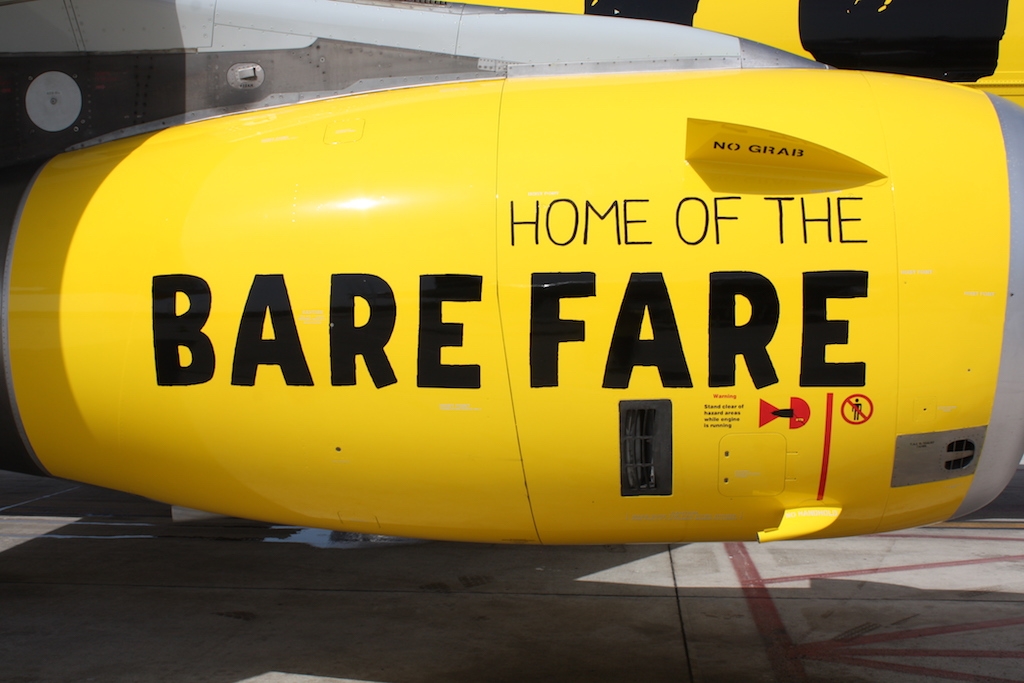
If you’ve ever wondered what’s behind Delta’s strategy in launching its Basic Economy fares, the low fares with seats assigned after check-in and no changes or refunds allowed, just ask the CEO of Spirit Airlines, whose airline is feeling the competitive heat from Delta’s inroads.
“From a consumer standpoint we really like it,” said Spirit CEO Ben Baldanza, referring to Delta’s Basic Economy push, “because it sends a very powerful message that if you pay less you should get less and if you pay more you should get more.”
In response to a question, Baldanza was outlining his view of Delta’s strategy to analysts at the Credit Suisse 3rd Annual Industrials Conference in Palm Beach, Florida December 3.
“And when you think about some of the pushback about Spirit as a business model with consumers, one of the biggest pushbacks we get with consumers is they buy us because they really like the fare but then are disappointed when we are not JetBlue or not Delta or not Virgin,” Baldanza said. “And so the [Delta] Basic Economy helps further that customer education. So overall, we think it is an effective strategy for the large airline and also works for our model as well.”
It is clear that Baldanza has a lot of respect for Delta’s management. “I think their Basic Economy fare is an example of good creative aggressive management,” Baldanza said. “Delta is very aggressive to a carrier like Spirit. They make it hard for us to grow in their markets.”
But how can Delta offer such rock-bottom fares without allowing them to eat into their higher fares?
“What we haven’t seen them do is try and actively sell a lot more Basic Economy,” Baldanza said. “What I think they are trying to do is use Basic Economy on the segment of their capacity that needs to be competitive for the most discretionary traveler, but not expose more of their inventory to that fare than they need to.”
And Basic Economy also creates an opportunity for the airline to up-sell services to passengers view the low fare but might want additional amenities and services, Baldanza said.
A Fan Boy of Delta’s Management
Baldanza said he doesn’t know if American and United will follow Delta’s lead with their own versions of Basic Economy. But of Delta’s strategy, Baldanza said: “But we generally think it is a very effective way to be aggressive against low-fare competition but protect their own revenue base.”
Throughout his talk, Baldanza argued that Spirit has the capability to compete and grow even in a tough competitive environment where there are low fuel prices and “very loud voices.” He was referring to officials from American Airlines, for example, who have vowed to aggressively match Spirit’s fares.
Baldanza said the resiliency of Spirit’s business model isn’t widely known, adding that the airline has the flexibility to quickly add or delete routes, as well as capacity. For example, even during the 2009 recession, Spirit had its highest margins in history up to that juncture, he said.
Baldanza said Spirit’s fundamentals are strong, although he acknowledged the airline must hit its quarterly guidance numbers.
He thinks Spirit can do that regardless of Delta’s Basic Economy initiative and vows Spirit plans to grow 20 percent in 2016 on a profitable basis.
As the 10th edition of the Riga Aviation Forum was getting ready to open, 50SkyShades — a long‑standing Media Partner of the event — took the opportunity to sit down with Zigmars Vestfals,...
Electra and The Atlas Group today announced a landmark airframe agreement for the EL9 Ultra‑Short aircraft, uniting Electra’s next‑generation design with Atlas’s established aerospace manu...
Qantas has inaugurated its new Product Innovation Centre in Adelaide, with South Australian Premier Peter Malinauskas joining Qantas Group Chief Technology, AI and Transformation Officer Rachel Yangoy...
Regional turboprop fleets show stark disparities in age, reliability, and economic viability. Many aircraft are approaching end‑of‑life, while others are increasingly difficult to operate as spare‑par...