


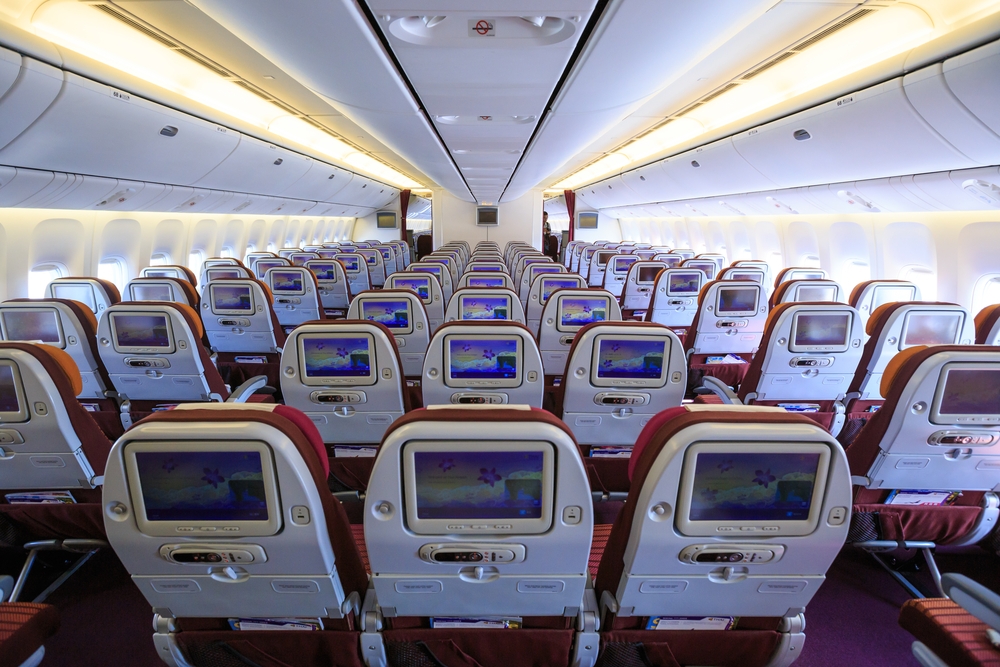
One of the airline trends we’re watching in 2016 was started by Airbus last summer: packing 11 seats per row on its A380 superjumbo jets.
It’s become a knee-crushing arms race, or, as the airlines like to call it, “cost savings.”
But, who really wins?
It’s not hard to argue that, in economy class today, the majority of the seats are too small.
Given the lack of competition, the mergers that have shaped the U.S. airline marketplace, and the health risks of sardine-esque legroom, there needs to be a simple minimum standard of at least 34 inches of seat pitch and 18 inches of width.
Last summer, Airbus floated a trial balloon — an 11-seats-per-row aircraft — where 10 abreast is already considered high-density. The news went over like a lead balloon. Public reaction was almost universally negative.
Incredibly, Airbus claimed it was “very satisfied” with its 3-5-3 economy class cabin design, which will meet the needs of a new breed of customer. Airbus has achieved this unprecedented compression by cutting seat width by an inch, slashing armrest widths by just over an inch, slanting window armrests outwards, and shrinking the aisles.
At some point, safety trumps capitalism. And that’s where government steps in.
In August, FlyersRights.org filed a formal Petition for Rulemaking with the Federal Aviation Administration (FAA) to set minimum standards guaranteeing each passenger adequate leg, hip and shoulder room.
Of course, the airlines hate this, and contend that minimum seat standards will lead to higher prices and fewer choices. But the reality is quite the opposite; such standards will level the playing field between airlines, and ensure that the price of an economy class airline seat on one airline is truly comparable to that of another airline.
There is no magic in the supposedly lower fares (and higher fees) charged by airlines that have cut back on legroom and seat sizes. One way or another, passengers still pay the price for smaller seats — if not in cash, then in bruised knees, broken laptops, increased respiratory illness, increased risk of Deep Vein Thrombosis (DVT), and air rage leading to diverted flights.
No middle ground. This is clearly a situation where the market has failed. Consumers desperately want a choice between crammed economy class and super-expensive first class. There is little middle ground for seat width, and people keep getting bigger. It’s not like most consumer products, where you get a range of options to suit your budget.
The airline industry’s argument that consumers already have a choice is laughable.
Business- and first class are almost completely cost-prohibitive for the average leisure traveler, so regulation is needed to ensure minimum comfort.
This reduction of passenger space in the quest for higher profits has created a critical situation by pushing the limits — not only of safety and comfort, but of health as well. Being confined in a small seat for several hours can be life-threatening.
We urge you to insist the FAA act now to stop the trend to smaller seats and jam-packed planes. You can have a say in what those standards will be.
“Tombstone mentality” is a mindset of ignoring design defects until people have died.
Looking at how passengers struggle getting into and out of seats now makes one wonder how they will escape in an emergency. One day, we will find that they cannot. Then, after hundreds of people have died, there might be a change.
You can show their support for seat standards by contacting their representatives and posting comments and opinions directly with the FAA.
No, we’re not advocating a nanny state; we’re simply saying that government must insist that airlines offer reasonable seating and traveling conditions.
It’s time for governments to stand up to the airlines in the name of their citizens. More than 3.6 billion passengers will fly in 2016. That’s almost half the world.
Airbus has officially unveiled a new delivery center at its Jean‑Luc Lagardère site, northwest of Toulouse, marking a significant milestone in the industrial ramp‑up of the A320 Family. Purpose...
Global Jet Capital has released its sixth annual Business Jet Market Forecast, outlining a confident outlook for the sector. The updated analysis anticipates steady expansion over the next five years,...
flydubai unveiled the launch of its dedicated freighter operations, a dynamic expansion that advances the airline’s diversification strategy and further elevates Dubai’s standing as a glob...
Boeing, TAROM and CDB Aviation have celebrated the delivery of the airline’s first 737‑8, marking the arrival of Romania’s first Boeing 737 MAX and a key milestone in the national carrier&...