


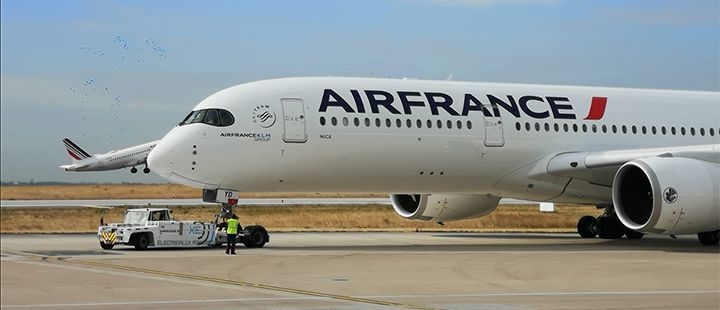
As part of its sustainable development policy, Air France has set itself the aim of halving its CO2 emissions per passenger km by 2030. To achieve this, the airline is doing all it can to reduce its carbon footprint at every stage of its value chain, both on the ground and on board.
For several years, Air France has been committed to using electric ramp equipment, and on 3 September 2020, tested the ramp handling of a Paris-Delhi flight using all-electric engines produced by French start-up CARWATT and TLD, the world leader in the construction of ramp equipment. Some of this equipment is certified by the Solar Impulse Foundation - of which Air France is a partner - for its ecological and economic value. The following equipment was used:
- for the aircraft’s air supply: a Lebrun TLD air conditioner
- for the transfer of baggage from the terminal to the aircraft, a Charlatte tractor
- for baggage loading: a CARWATT conveyor belt
- for cargo loading, a TLD wide-body TLD loader
- Finally, the aircraft was pushed back from its parking stand by a TLD wide-body tug.
Supporting innovation and mobilizing its ecosystem to develop economically and ecologically viable solutions is one of the major priorities of Air France's sustainable development policy. The airline therefore supports the development of innovative aircraft offering alternatives to the use of fossil fuels. The partnership between Air France and CARWATT, launched in 2017, combines electrification and circular economy, with the transformation of old thermally powered baggage carousels into electric-powered carousels with second-life Li-Ion batteries. TLD, Air France's supplier and long-time partner, is using the Air France hub at Paris-Charles de Gaulle as a testing ground for the development of its engines. Air France and TLD engineers will soon be testing the self-guided aircraft approach in real-life conditions (equivalent to a "park assist" on cars) for the new electric loaders used to load cargo on board aircraft.
By the end of 2020, close to 60% of the fleet of ramp equipment used by Air France at airports where the airline operates its own equipment (Paris-Charles de Gaulle, Paris-Orly and Air France stations in mainland France) will be electric. This rate will be increased to 90% in 2025, making it possible to save 10,000 tons of CO2 emission every year. By 2030, Air France aims to make its ground operations carbon neutral.
The Paris-Delhi flight on 3 September 2020 was operated by an Air France Airbus A350, a latest-generation aircraft that consumes 25% less fuel than the equivalent aircraft of the previous generation, thanks to the incorporation of lighter materials, composites and titanium. Its noise footprint is also reduced by 40%.
Air France's sustainable development commitments also cover fleet renewal, eco-piloting, recycling, offsetting CO2 emissions, the use of sustainable aviation fuels and mobilizing research. For more details on the Horizon 2030 plan, click here.
For fifteen consecutive years, the Air France-KLM Group has ranked first in Europe and the world in the Dow Jones Sustainability Index (DJSI), the main international index assessing performance in terms of sustainable development, and regained the top spot in the rankings in 2019.
ExecuJet MRO Services South Africa, a wholly-owned subsidiary of Dassault Aviation, will be exhibiting at the Africa Aerospace & Defence (AAD) Expo 2026 at Waterkloof Air Force Base in Pretoria (1...
Global Jet Capital has released its sixth annual Business Jet Market Forecast, outlining a confident outlook for the sector. The updated analysis anticipates steady expansion over the next five years,...
Regional turboprop fleets show stark disparities in age, reliability, and economic viability. Many aircraft are approaching end‑of‑life, while others are increasingly difficult to operate as spare‑par...
EHang announced its extensive involvement in the FIA Sustainable Innovation Series held in Madrid during the Formula 1 Spanish Grand Prix week. Organized by the Fédération Internationale...