


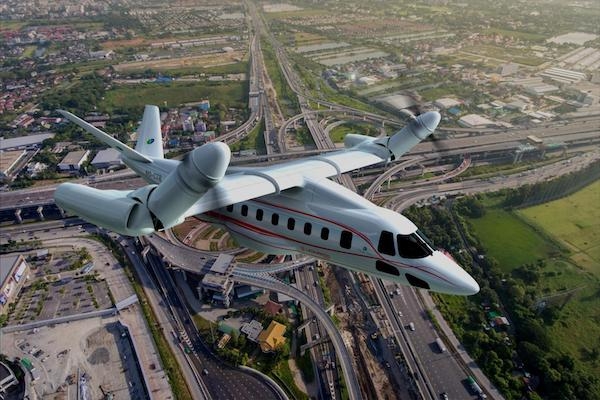
Thanks to the European consortium FORMOSA developed a new solution for the mobile surfaces of the wing that reduces fuel consumption and improves performance during flight. FORMOSA project has come to an end. It was launched in 2020 to redesign the wing control surfaces of the NextGen Civil TiltRotor (NGCTR-TD) produced by Leonardo. The new configuration proved capable of reducing the wake load on the wings in helicopter mode (-9% compared to the original design) allowing reduced fuel consumption during vertical take-off and landing manoeuvres. In addition, a significant improvement in roll performance was achieved during flight in airplane mode, thanks to a 25 per cent reduction in the time-to-bank, the time needed to reach the required turning angle.

What is a tiltrotor?
A tiltrotor is a hybrid aircraft that combines the characteristics of a helicopter with those of an airplane. The architecture of tiltrotors features two rotors, placed at the wingtips, which can rotate allowing the aircraft to take off (and land) vertically and, once the take-off manoeuvre is complete, rotate forward to turn into propellers, producing the thrust for flight, as in a classic propeller plane. In order to manoeuvre these aircraft, it is necessary to design control surfaces suitable for the different flight phases.
The NextGen Civil TiltRotoris a technology demonstrator designed by Leonardo as part of the European Clean Sky 2 programme and created to meet, among other things, the growing need for air mobility in densely populated urban areas, offering the opportunity to take off and land vertically like a helicopter, together with the high speed and long distance capability typical of airplanes.
In order to improve the aircraft performance, Leonardo promoted the development of a unique and innovative solution for the wing's moving surfaces, capable of incorporating multiple functions, reducing the weight of the aircraft and the complexity of the control system and thus, ultimately, the emissions produced by the during missions.
The new configuration presented by the FORMOSA consortium took up the challenge and realized a special wing that includes more effective moving surfaces controlled by a new actuation system, which will be flight-tested as part of Clean Sky 2. The new calculation methods made it possible to correctly determine the airflow on the wing, which is affected by the aerodynamic interference of the rotors not only during stationary flight phases but also and especially during manoeuvring phases.
The technology developed by FORMOSA opens up the possibility of further optimisations including, in addition to flight in helicopter or airplane mode, tiltrotor flight configurations for short take-off, landing and approach.
The FORMOSA consortium consists of a group of young researchers from Politecnico di Milano and a team of engineers from the Portuguese company Centre of Engineering and Product Development. The project, coordinated by Prof. Vincenzo Muscarello, was funded by the project Clean Sky 2, one of the objectives of which is to build new generation aircraft that are less polluting.
Qantas has inaugurated its new Product Innovation Centre in Adelaide, with South Australian Premier Peter Malinauskas joining Qantas Group Chief Technology, AI and Transformation Officer Rachel Yangoy...
Boeing, TAROM and CDB Aviation have celebrated the delivery of the airline’s first 737‑8, marking the arrival of Romania’s first Boeing 737 MAX and a key milestone in the national carrier&...
Global Jet Capital has released its sixth annual Business Jet Market Forecast, outlining a confident outlook for the sector. The updated analysis anticipates steady expansion over the next five years,...
Gol Airlines continues to expand its South American reach, leveraging its Brazilian network to open new travel possibilities. European passengers can now access southern Argentina through São P...