


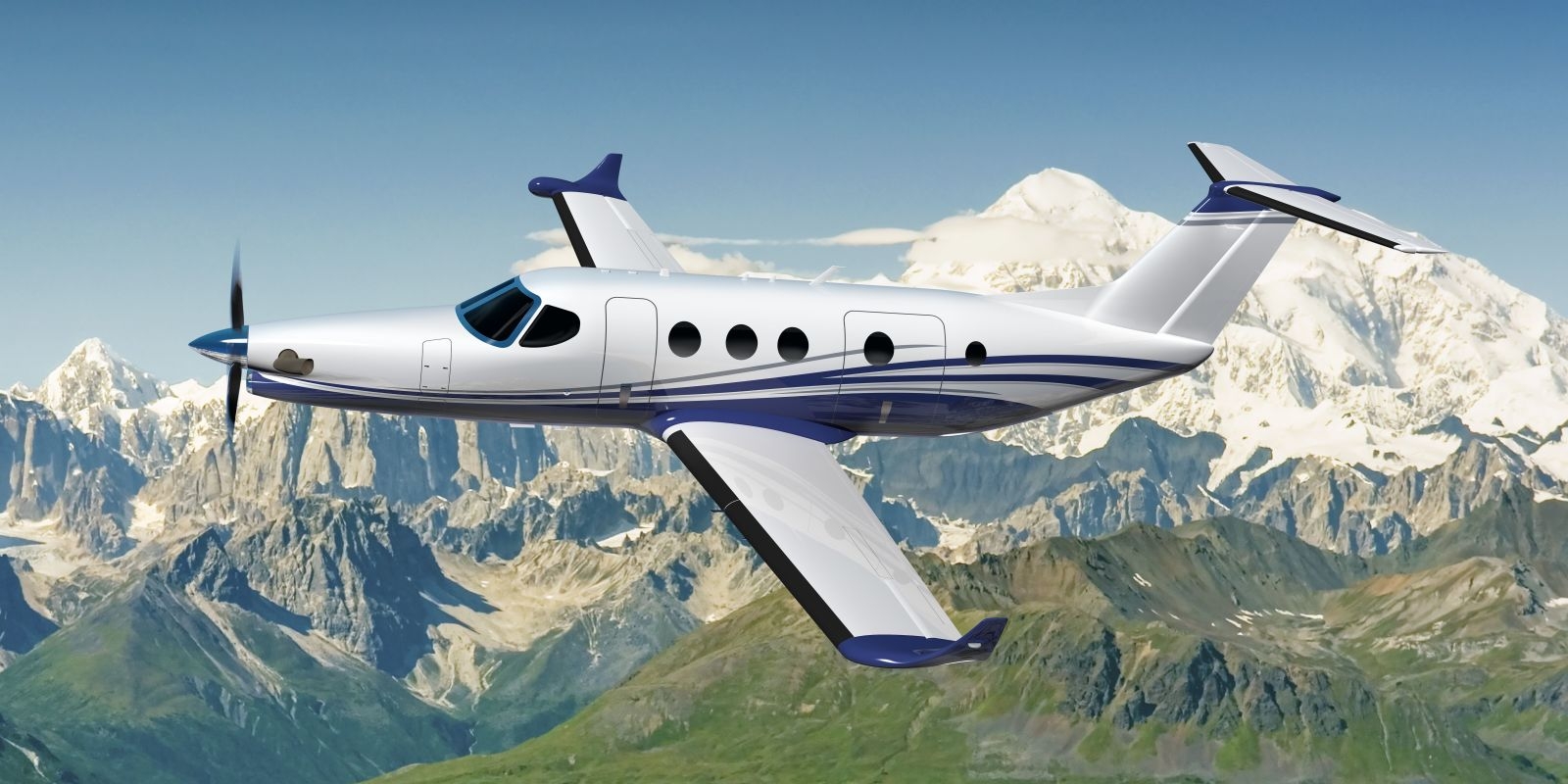
Textron Aviation recently announced their new Cessna Denali business aircraft at the EAA AirVentures airshow in Oshkosh, Wisconsin. The plane is designed to offer all the comforts and conveniences of a private jet, but at a fraction of the manufacturing price, thanks in part to its turboprop engine.
General Electric Aviation, which developed the advanced turboprop (ATP) for the Denali, included a few novel features in the engine to make the aircraft as jet-like as possible. For one thing, a number of the components on the turboprop will be 3D-printed from titanium and steel, eliminating the need to manufacture hundreds of smaller parts. It's tech that GE has been diving into headfirst, and this is one of its first major applications. Full Authority Digital Engine Control (FADEC) will integrate the engine and propellor control into a single lever, giving the pilot aircraft controls that operate more like a jet than a turboprop.

GE's advanced turboprop engine (ATP).
The new turboprop also leverages some traditional jet-engine technology to increase the pressure and temperature in the compressor, which helps the engine provide a massive 1,240 shaft horsepower—all while burning 20 percent less fuel than other engines in the same class. Carbon composite propellors with reversible pitch and ice protection will help the Denali perform short landings and fly in cold conditions, and a 1,600-nautical-mile range means the Denali has plenty in the tank to fly from New York to Miami.

Concept image of Textron Aviation's Cessna Denali turboprop business aircraft.
The cabin on the Denali will be the largest in its class, with room for eight passengers comfortably arranged in a business jet-like interior. The business propellor plane is expected to cost around $4.8 million, and first flight is slated for 2018. In the meantime, take a close look inside the H-series turboprop in an amazing animated cutaway diagram.
Drukair – Royal Bhutan Airlines, the national flag carrier of the Kingdom of Bhutan, has announced its decision to equip five Airbus A320neo‑family aircraft with CFM International LEAP‑1A engine...
KVE by Daher is marking its 30th anniversary with the inauguration of a significant expansion of its production facility in The Hague — a development that signals the start of a new acceleration...
Just two months after acquiring VoltAero’s assets, AURA AERO has returned the Cassio S hybrid‑electric demonstrator to the skies at Rochefort Airport—now flying under its new name, X‑VOLT....
Gol Airlines continues to expand its South American reach, leveraging its Brazilian network to open new travel possibilities. European passengers can now access southern Argentina through São P...