


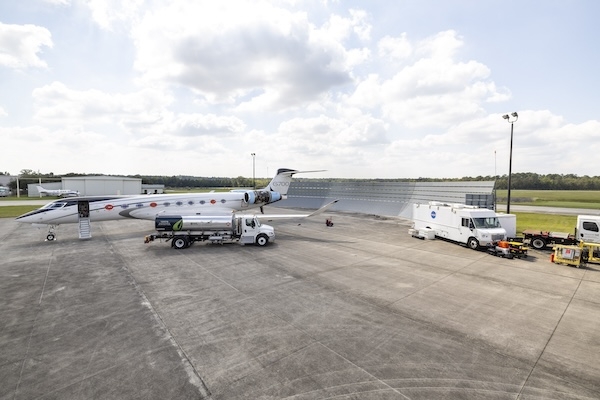
Gulfstream Aerospace successfully completed ground emissions testing of 100% neat sustainable aviation fuel (SAF) containing zero sulfur on the all-new Gulfstream G700. Powered by Rolls-Royce Pearl 700 engines, the G700 ground emissions test was conducted to measure multiple fuel types, including a 30/70 SAF blend and neat SAF (a non-fossil-based aviation fuel). The preliminary results of these tests will inform the industry’s path in further reducing the overall climate impact of business aviation.
Mark Burns, president, Gulfstream commented: “Gulfstream has a rich history of innovating for sustainable aviation dating back to 2004 with the first ISO certification for our Savannah facility. Our journey continues today as we work to enhance our understanding of fuel properties and their environmental characteristics to assess business aviation’s impact on the climate, chart the path forward in decreasing that impact and lead the industry in driving its sustainable aviation goals. We’d like to extend a big thank you to our partners — the FAA, NASA, Aerodyne Research, Missouri S&T, Rolls-Royce, World Energy and World Fuel Services — without which none of this research could have been possible. These partners are key to our ongoing success and the success of the entire industry in continuing to innovate and drive positive environmental change for business aviation."

This ground emissions testing was conducted at Gulfstream’s Savannah facility using 100% neat SAF provided by World Energy and shipped by World Fuel Services. Gaseous and particle measurements from the weeklong testing event were recorded using special instrumentation from the Federal Aviation Administration (FAA), NASA, Aerodyne Research and Missouri University of Science and Technology.
The key objective was to understand the environmental characteristics of different fuels, especially 100% neat SAF without sulfur contamination or aromatics. Through meticulous attention to fuel integrity, preliminary data indicates minimal to no sulfur contamination of the fuel and a decrease in greenhouse gas production. The test results demonstrate the potential of 100% neat SAF for improving local air quality near airports as well as the possible benefits of reducing the formation of condensation trails.


Boeing, TAROM and CDB Aviation have celebrated the delivery of the airline’s first 737‑8, marking the arrival of Romania’s first Boeing 737 MAX and a key milestone in the national carrier&...
flydubai unveiled the launch of its dedicated freighter operations, a dynamic expansion that advances the airline’s diversification strategy and further elevates Dubai’s standing as a glob...
Global trade body The Air Charter Association (The ACA) celebrated another record‑setting edition of Air Charter Expo (ACE’26) on Tuesday, 8 September 2026, delivered in partnership with Busines...
Global Jet Capital has released its sixth annual Business Jet Market Forecast, outlining a confident outlook for the sector. The updated analysis anticipates steady expansion over the next five years,...