


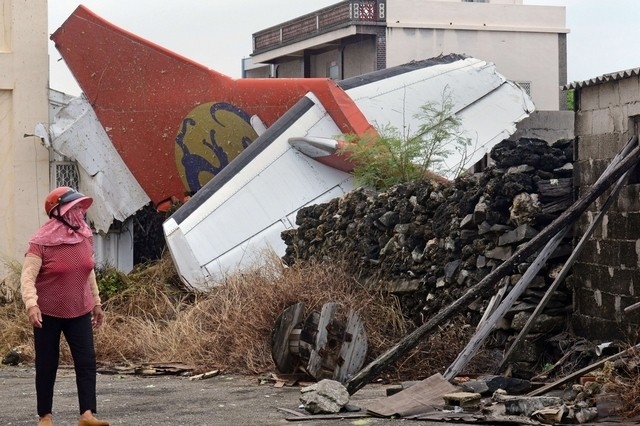
Two TransAsia Airways pilots caused a 2014 plane crash that left 48 people dead by flying too low as they attempted to land on an island during a typhoon, Taiwan’s aviation authorities said Friday.
Taiwan’s aviation body said the pilots flew below the minimum altitude required in poor visibility caused by Typhoon Matmo on July 23, 2014, in its final report into the airline’s second fatal accident in a year.
The procedural mistake was widespread among TransAsia’s pilots at the time, an aviation official said, endangering passenger and crew safety.
Ill-fated Flight GE222 was carrying 54 passengers and four crew when it slammed into trees and houses near Magong city airport in the Taiwan Strait’s scenic Penghu islands, leaving just 10 survivors.
Two French nationals were among those killed in the island’s worst air disaster in a decade.
“An airworthy aircraft under the control of the flight crew was flown unintentionally into terrain with limited awareness by the crew of the aircraft’s proximity to terrain,” the Aviation Safety Council said in the investigation report.
The ATR 72-500 propeller plane had deviated off course during thunder and heavy rain as Typhoon Matmo pounded Taiwan.
“They were not visual with the runway environment, contrary to standard operating procedures,” the report said.
According to flight safety regulations, the pilots were required to maintain their altitude when their plane descended to 100 metres, but the aircraft continued to descend.
“We found the pilots did not follow the standard operating procedure,” council director Thomas Wang said.
“Then we discovered TransAsia’s team of pilots flying the ATR fleet also had similar problems, and we wanted to know why the carrier tolerated this among its pilots, and why the Civil Aeronautics Administration (CAA) did not discover this while carrying out regular inspections,” he said.
Mr Wang said “the company’s pilots were flying without abiding by standard procedures, part of a workplace culture which endangered flight safety”.
According to transcripts of the plane’s two black boxes, which record voices in the cockpit and other in-flight data, the co-pilot twice replied “no” when asked by the pilot whether he had seen the runway.
The investigation report identified a range of other aggravating factors, including poor communication of weather information to the flight crew, and coordination issues at Magong airport.
The Flight GE222 crash came seven months before TransAsia Airways Flight GE235 clipped a bridge and plunged into a river in Taipei shortly after take-off with 53 passengers and five crew on board. Forty-three people died.
Disturbing cockpit transcripts from the second crash revealed by the council showed pilots trying to deal with an engine which had lost power, but then reducing the thrust of the other, functioning engine.
Drukair – Royal Bhutan Airlines, the national flag carrier of the Kingdom of Bhutan, has announced its decision to equip five Airbus A320neo‑family aircraft with CFM International LEAP‑1A e...
KVE by Daher is marking its 30th anniversary with the inauguration of a significant expansion of its production facility in The Hague — a development that signals the start of a new acceleration...
EHang announced its extensive involvement in the FIA Sustainable Innovation Series held in Madrid during the Formula 1 Spanish Grand Prix week. Organized by the Fédération Internationale...
Boeing, TAROM and CDB Aviation have celebrated the delivery of the airline’s first 737‑8, marking the arrival of Romania’s first Boeing 737 MAX and a key milestone in the national carrier&...